This booklet explains what LangTominoes are and gives examples of what you can do wth them. Be sure to see the main web page for Langford's Problem in References at the end. Also see the "Bar Bets" page for other zany ideas!
What are LangTominoes?
Each "LangTomino" physically embodies the entanglement
of a pair of numbers as defined in Langford's Problem:
The numbers of each pair always keep their unique distance from each other.
Wait! What is Langford's Problem!?
Langford's Problem asks how we can fit such pairs of numbers into a complete arrangement, without gaps.
Each LangTomino represents a solid / rigid pair, allowing you to easily move pairs around while you experiment with arrangements.
Physically, LangTominoes have two "prongs", each representing a pair of numbers — a pair of 1's, a pair of 2's, a pair of 3's, and so on.
For the number 'k', the two prongs are separated by k units.
Each prong is one unit wide because
each number of the pair takes up one location in the arrangement.
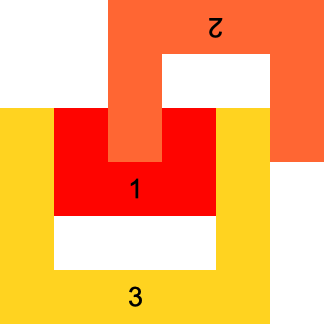
Diagram of LangTominoes 1, 2, 3 fitting together without gaps
True Langford arrangements can be done with N pairs, only if N is a multiple of 4, or one less. Eg {3, 4, 7, 8, 11, 12, 15, 16, ...}.
There are no proper arrangements possible for 5 or 6, or any N not in the above sequence.
Partial Arrangements
As above, true Langford arrangements can be done with N pairs, only if N is a multiple of four, or one less. (Eg 3, 4, 7, 8, 11, 12...).
However, partial arrangements can be made with a subset of LangTominoes.
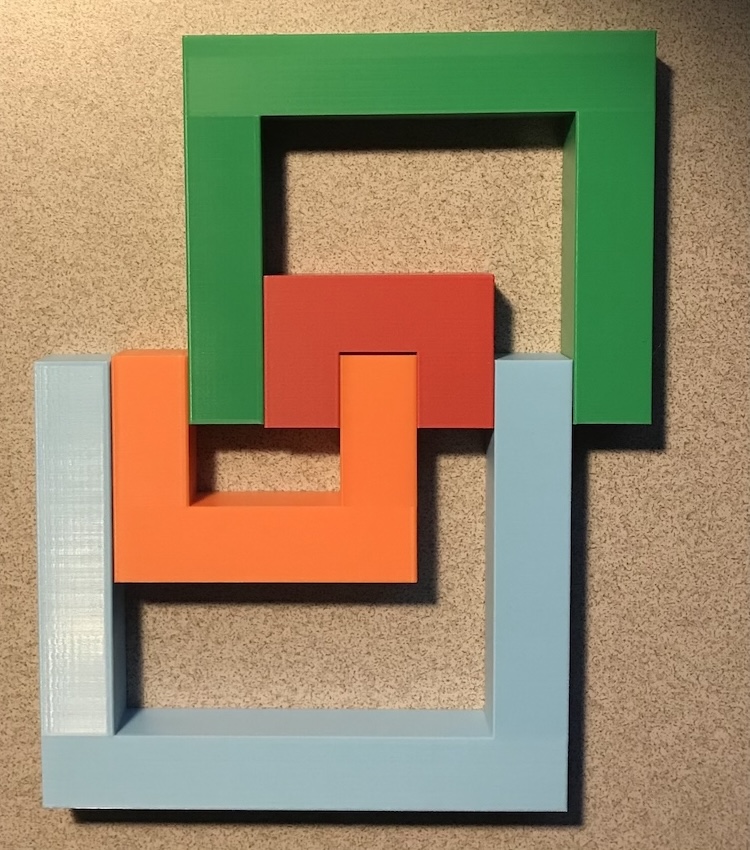
Knuth's arrangement of 5-2-4-1
We leave it as an exercise for the reader to figure out what conditions need be met before a subset of pairs will fit together with no gaps.
Planar Solutions
A planar solution is one where all the Langtominoes lie flat on the plane (table).
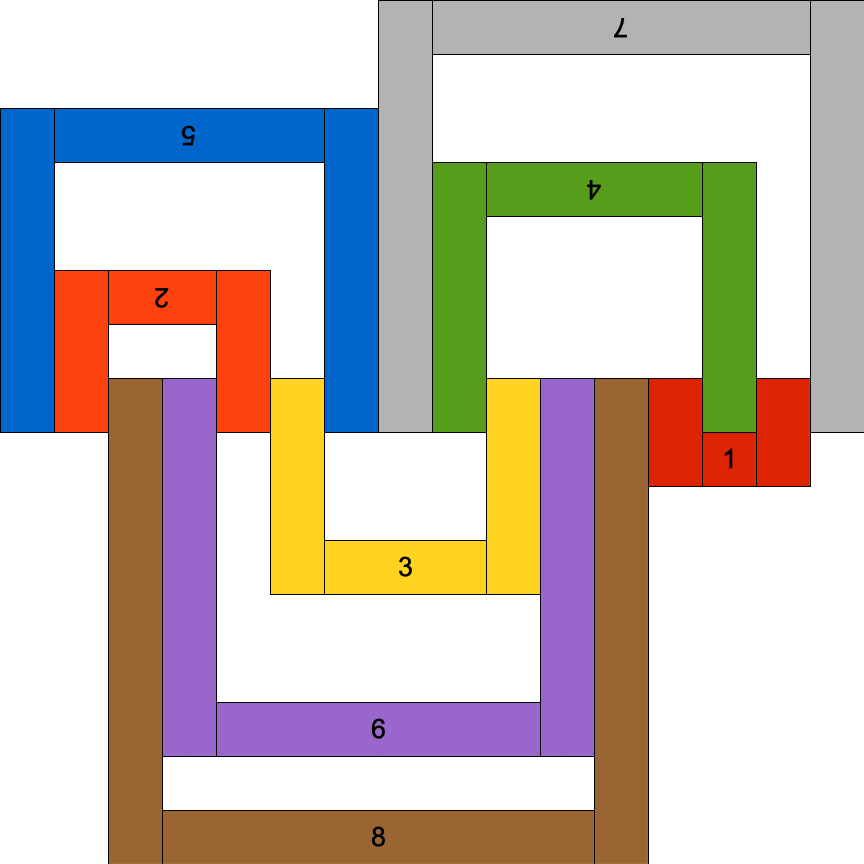
Diagram of LangTominoes 1-8 representing the planar solution 5286235743681417
Try assembling this with your set of LangTominoes!
PHOTO of LangTominoes 1-8 printed in Canada by ItemsByCL
LangTominoes can Stand Up!
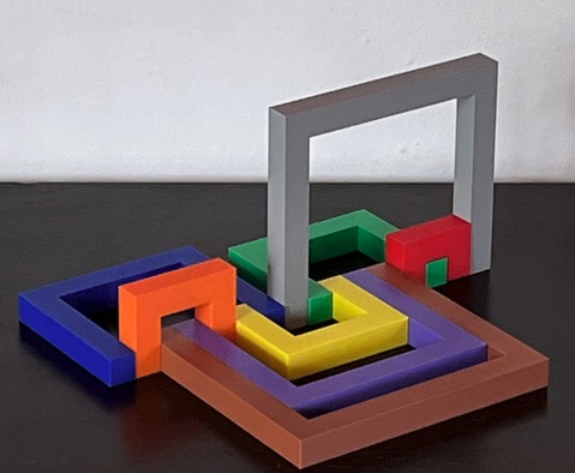
Gerhard Hotter's lovely arrangement for n=8
In Hotter's arrangement, the ones standing up could be laid flat — the orange '2' could lie back into the blue space, the red '1' could tip forward onto the open table, and the tall gray one could lie back, surrounding the green LangTomino.
So, this is technically the same 2D planar arrangement shown next above, with some standing for attention.
8
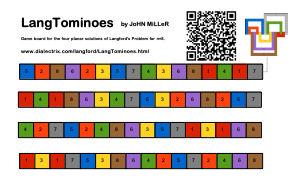
Here are the (only) four planar solutions for n=8:
*This solution is depicted in the above diagram and photo.
We have these four planar solutions for n=8 represented on a "Game Board".
Download and print the LangTomino Game Board on legal size paper, or just refer to it on your device.. It has an accurate color key for the four planar solutions for n=8.
[PDF]
LangTomino Board for Practicing.
7
There are no strictly planar solutions for n=7, but there are '3D solutions'!
See that section below.
'3D' solutions
True planar solutions can have all the pieces flat on the table.
What if you were allowed to stand a selected LangTomino up (on its two prongs) using a '3rd' dimension? Spatially, you'd use a vane orthogonal to the solution in progress. That way, you can avoid other LangTominoes in space, bridging up and over other prongs to connect two vacant positions, thereby realizing more solutions than just lying flat on the plane.
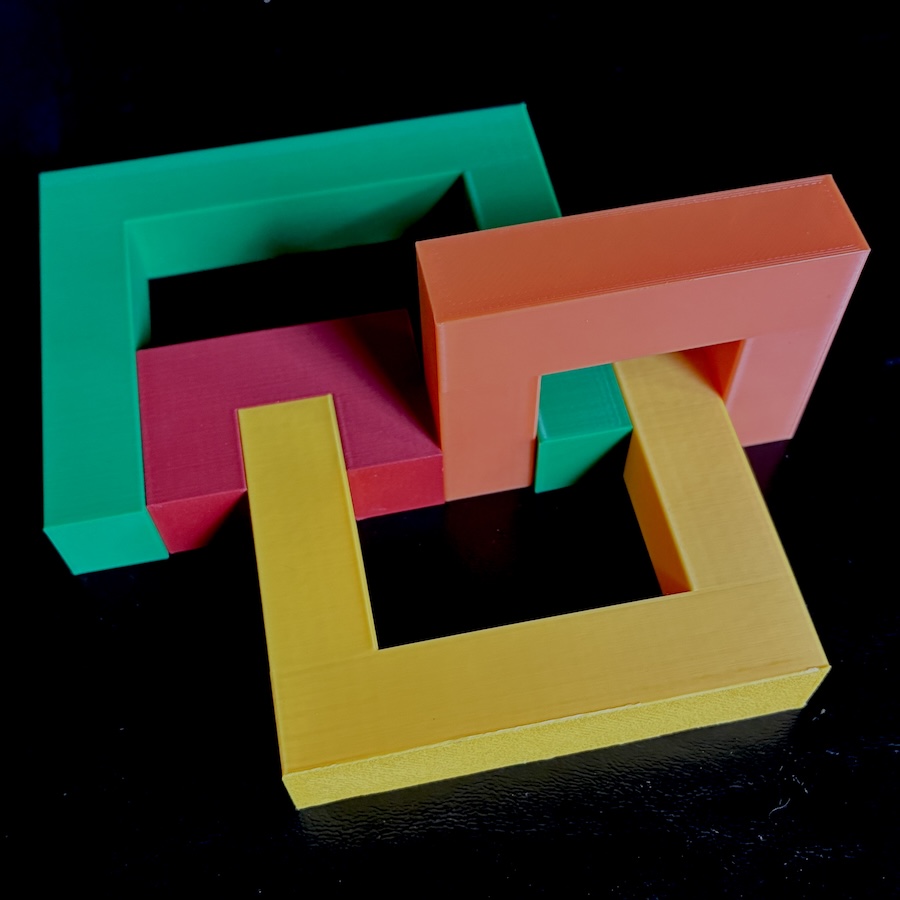
3D version of 4, with '2' standing up.
Vanes
'3D' could likewise go 'down and under' (the table) to connect two vacant positions.
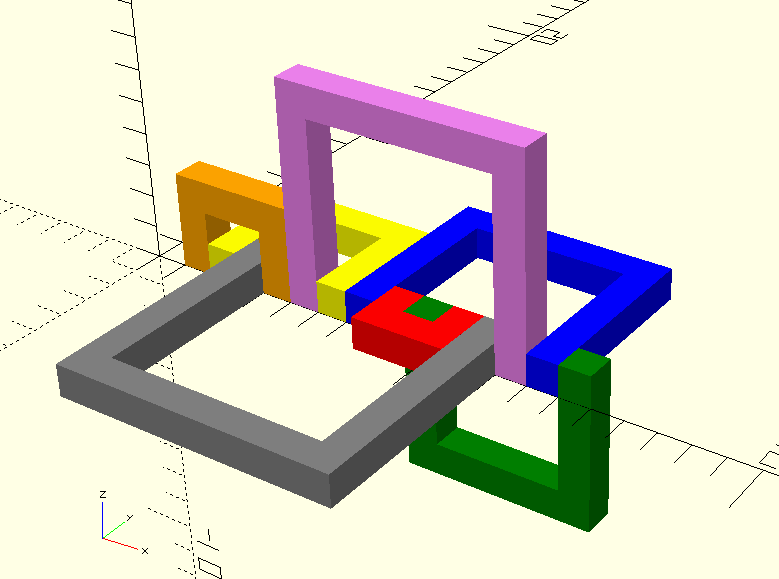
OpenSCAD render of a 4 Vane arrangement for N=7
Vanes are semi-planes where connections can be made independent of connections in other vanes. Three vanes can be realized with LangTominoes by standing some up on their prongs. Unfortunately we don't (currently) have a way of working with all four vanes, except perhaps in Zero Gravity!
There are likely multiple ways of constructing any given solution / arrangement.
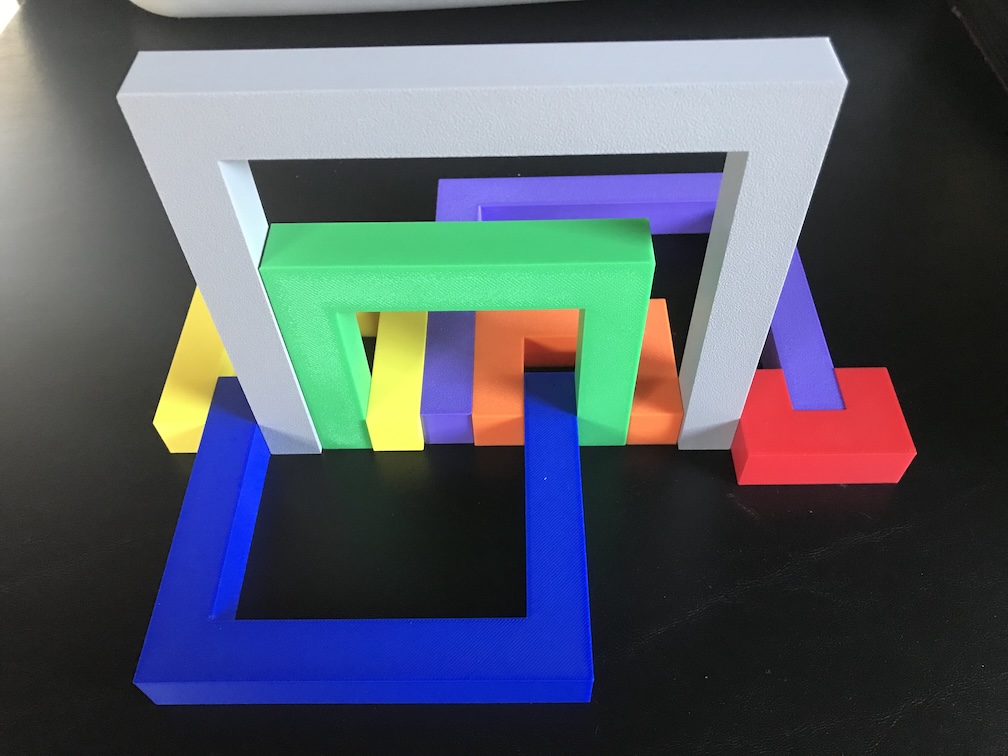
N=7 3D solution
All solutions for 7 are technically non-planar, but the one above is one realized with LangTominoes.
Those standing up can't lie down - they need to jump over other LangTominoes.
Note that LangTominoes do not extend the number of solutions to the classic Langford's Problem, but they do extend the notion of planarity to another dimension.
Serious Exercises!
We challenge you to try to construct all 26 solutions for 7 and
the 150 solutions for 8 using LangTominoes.
There are no Planar solutions for 7, and 8 has only four, so you will need to stand some LangTominoes up on their prongs, and perhaps think of one or more pointing 'up' from below.
For your reference, here the 26 solutions for 7, and the 150 solutions for 8.
[LINK]
Questions we have
The Big Question is… Can We 'Do' all solutions with LangTominoes? If not, how many Can We Do for a given N?
Can you tell how many vanes would be needed, simply by scanning a given solution Left-to-Right?
Any ideas on how to modify the pieces so they might connect nicely with each other?
We need a Notation for LangTomino arrangements. Any ideas?
Might there be a Two-player Game using one or two sets?
G4G16 Bar Bets, in San Francisco - Some Zany arrangements!
[LINK]
Lists of the 26 solutions for 7, and the 150 solutions for 8.
[LINK]
Definitions
prong
1. each of two or more projecting pointed parts at the end of a fork.
1a. a projecting part on various other devices:
a small rubber brush with large prongs.
2. each of the separate parts of an attack or operation: the three main prongs of the new government's program.
vane
the flat part on either side of the shaft of a feather (or arrow).
Please Honor this Creative Commons License
John Miller has spent a good amount of time developing this concept and preparing the information presented here.
So, he is placing this LangTomino page under a Creative Commons Attribution-NoDerivatives 4.0 International license
[CC BY-ND 4.0].
All John asks is notification and attribution of any use of the LangTomino form.
Please send notifications to TimeHavenMedia @ gmail.com — Thank You!